
The Cavern

Rock & Words

Just Like Starting Over...


Click on the pic above to go to the logo band Index
RECENT POSTS
Harry Styles: Together, Together (Editorial)
La Revo - Intro (Edited and Improved)
Back To The Begining (New Concert Review)
Led Zeppelin Intro (Rewritten)
Another Side Of Bob Dylan (New Album Review)
The Doors (Edited and Improved Intro)
The Rolling Stones (Edited & Improved)
THE 27 CLUB: Myth, Tragedy and… Statistics?
Okay, I've had this topic on my mind for about 15 years, and now with the new format from the publishers, I can finally put it together the way I want. I was thinking of making a shorter post, but there's quite a lot to cover, and I don't want to just analyze the same seven main figures that appear on every list.
To begin (and this could be a whole other topic for another editorial), certain ages seem to acquire their own significance in the history of music: 19 years old for many teenagers, when most already have a band and are starting to hone their craft in bars, playing covers and gradually finding their own identity and fanbase as they become more confident in writing their own songs, with each member contributing their influences; 25 as the creative peak of the band, still full of energy, dazzled by fame, still without responsibilities; 30 as a symbolic boundary of youth, with band members usually starting families, maturing, and generally developing different interests; and 40 as the beginning of a new stage of greater introspection and maturity, with tours and albums becoming increasingly infrequent because each member has different interests and responsibilities, wanting to spend more time with their families, if they aren't starting a second or third. But no age carries such a dark weight in rock as 27.
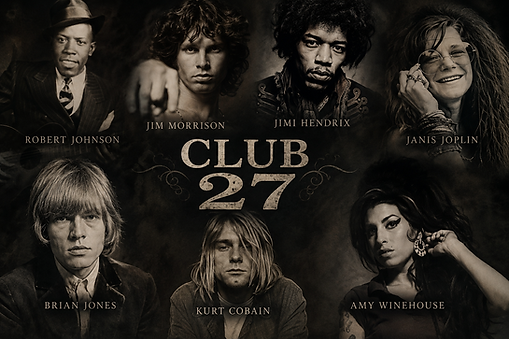
The seven most well-known names in the infamous 27 Club are Robert Johnson, Brian Jones, Jimi Hendrix, Janis Joplin, Jim Morrison, Kurt Cobain, and Amy Winehouse. Artists separated by generations, styles, and different circumstances, but united by a chilling coincidence: they all died at the age of 27.
Some were victims of drugs and alcohol. Others died in accidental or unclear circumstances. One committed suicide. Some had achieved extraordinary fame; apart from those seven, others were virtually unknown outside their musical circles. As time passed, their names were cataloged under a title that would become one of the great myths of popular culture: The 27 Club.
The question that's been nagging at me for a while now is: Is there really anything statistically special about dying at 27? I mean, is it truly an age with a statistical peak, or is it just because there are several famous names? Obviously, I don't want to analyze older ages (life insurance premiums are higher, after all), but, say, under 35, are there other ages with similar peaks? Fifteen years ago, I could only speculate, but one of the advantages of being in 2026 is that there's AI, and although most of this editorial is handwritten—well, typed, you get the idea—I've taken advantage of technology to resolve some doubts and obtain a lot of interesting data.
Let's start by reviewing these 7 most notable figures of the 27 Club and why they are so important:
Robert Johnson:
Robert Johnson died on August 16, 1938, at the age of 27.
This would be the origin of the legend. It's already common knowledge that he was one of the great pioneers of American blues, and although he didn't achieve the fame he would later attain during his lifetime, his influence on rock was monumental. For example, his 1961 album, *The King of the Delta Blues*, blew the minds of figures like Eric Clapton, Jeff Beck, Bob Dylan, Jimmy Page, Jimi Hendrix, Brian Jones, and basically any British guitarist of the first half of the 1960s, who became what they became in their vain attempt to emulate Robert Johnson's sound. To give you an idea, Clapton admitted that he didn't truly understand Johnson until the *From the Cradle* era, even though he didn't include any of Johnson's songs on the album. His figure is surrounded by legends, especially the one that claims he sold his soul to the devil at a crossroads in exchange for becoming the best guitarist in the world.
Johnson left behind only a handful of recordings, but songs like "Cross Road Blues ," "Hellhound on My Trail, " and "Sweet Home Chicago" became cornerstones of blues history. His death is also shrouded in mystery. The exact cause was never clarified. For decades, poisoning, syphilis, pneumonia, and worse—like jealous and violent husbands—have been the subject of speculation, but neither his death nor his burial place has ever been definitively established.
It's important to clarify that Johnson died long before the concept of the 27 Club existed. He died without being famous. His fame only came when a large group of guitarists in the 1960s unanimously recognized him as their idol. Therefore, the 27 Club didn't actually begin with Robert Johnson; it was retrospectively incorporated into the legend. For decades, no one spoke of a "club." The idea only began to take shape much later.
Brian Jones:
On July 3, 1969, Brian Jones, founder, guitarist, multi-instrumentalist, and undeniable genius of The Rolling Stones, died. He was 27 years old.
Brian would technically be the first link in the tragedy, although his death itself was an isolated incident and no one was yet talking about any club. Jones had been THE essential figure in the Stones' early years. Although he was later overshadowed by the creative duo of Mick Jagger and Keith Richards, he was originally the musical leader and the one who gave the group much of its instrumental identity. But his relationship with drugs and alcohol, his personal problems, and his conflicts with the rest of the band (including the fact that Keith stole his girlfriend) gradually deteriorated his mental state.
Just weeks after being kicked out of the Rolling Stones, Jones drowned in the swimming pool of his home in Sussex, England. The official inquest concluded that he died by drowning and classified it as an accidental death, although in recent years a theory has emerged that he was killed by a contractor who worked for him and whom he had forgotten to pay a few pounds.
The fact is that Brian Jones died in 1969. And that during the following two years an extraordinary succession of events would occur, worthy of a Greek tragedy.
Jimi Hendrix:
On September 18, 1970, a little over a year after Jones's death, came Jimi Hendrix's. Yes, he was 27 years old.
Hendrix was the guitarist who changed history. He had revolutionized the electric guitar in just a few years. Legend has it that when Clapton was recording Disraeli Gears with Cream and heard Are You Experienced?, he smashed a guitar in true Townshend style. With The Jimi Hendrix Experience, the left-handed guitarist had transformed the instrument's possibilities, combining blues, psychedelia, rock, and sonic experimentation. His influence was immediate and enormous. If that first generation became guitarists trying to emulate Johnson's sound, the great guitarists of the late '60s and early '70s did the same, with Hendrix as their goal. The same, but with distortion. And wah-wah.
Hendrix also led a life marked by exhaustion, drugs, and a brutal work pace. He died in London after mixing barbiturates and alcohol. The medical cause of death was asphyxiation due to aspiration of vomit. He was 27 years old and had only been at the top of the music world for about three years.
Janis Joplin:
Just 16 days after Hendrix's death, on October 4, 1970, Janis Joplin died. She was also 27 years old.
Janis Joplin was one of the most powerful voices in rock. She had been the lead singer of Big Brother and the Holding Company before joining the Kozmic Blues Band. Her raspy, raw, and deeply emotional voice transformed songs into classics that still resonate powerfully today.
But Janis also struggled with a severe addiction to hard drugs and alcohol. She died in Los Angeles from a heroin overdose. She was 27 years old. She seemed to have finally found a stable relationship with Kris Kristofferson.
Here's one of the elements that made the coincidence start to seem strange, to say the least: In just over a year, Brian Jones, Jimi Hendrix, and Janis Joplin had all died at the age of 27. One swallow doesn't make a summer, but one of the most important names was still missing.
Jim Morrison:
On July 3, 1971, exactly two years after Brian Jones' death, Jim Morrison, singer and frontman of The Doors, died. He was 27 years old.
The Lizard King had become one of the great symbols of psychedelic rock and the 60s. His deep voice, his poetry, his provocative behavior, and his stage presence made The Doors one of the fundamental bands of the late decade, with albums and songs that are cornerstones of rock history.
After recording LA Woman in 1971, Jim Morrison moved to Paris with Pamela Curson, seeking to get away from fame and his personal and legal problems, and reportedly to finally come to terms with leaving The Doors for good.
On July 3, 1971, he was found dead in the bathtub of his apartment. The official cause was heart failure. No autopsy was performed, but rumors always maintained that he mistook his cocaine for Pam's heroin, a drug he wasn't used to.
The interesting thing is that Morrison died exactly two years after Brian Jones. By then, four major rock figures had died at that age in just two years. In other words, it wasn't just one swallow anymore!
Although no one had yet formally constructed the concept of the "27 Club", the seed of the legend had already been sown.
Kurt Cobain:
This was the definitive birth of the "Club". If the deaths of Jones, Hendrix, Joplin and Morrison created the coincidence, Kurt Cobain helped create the modern myth.
The vocalist, guitarist, songwriter, and leader of Nirvana died on April 5, 1994. He was 27 years old. I think I've already mentioned this, but his death really affected me, and for a year I was convinced it was just cheap marketing or rumors, until the first anniversary of his death…
Cobain, whether we like it or not, had transformed 90s music with Nirvana, opening the door to grunge and becoming one of the symbols of the grunge generation. I might only like 30 or 40% of the music he made, but that doesn't mean I can't recognize that he changed the course of the decade and abruptly buried the superficiality of the 80s.
Her death was ruled a suicide. Although rumors have also surfaced recently…
The curious thing is that, according to later research into the history of the term, it was precisely after Cobain's death that the idea of the "27 Club" began to truly gain traction in popular culture. His mother, Wendy O'Connor, made a statement in an interview with an Abredeen newspaper in which she referred to her son as having joined a "stupid club." That phrase, that precise moment, later contributed to fueling the narrative and creating the myth. It was no longer the 1960s, and although the hyperconnectivity and instant virality of today didn't exist, information already traveled very quickly in the 1990s.
From then on, the age of 27 ceased to be merely a coincidence.
Amy Winehouse:
Amy Winehouse died on July 23, 2011. She was 27 years old.
Amy was the last big name. Winehouse had achieved something extraordinarily difficult: turning a mix of soul, jazz, rhythm & blues, and pop into mainstream music. Her album Back to Black made her a global star. I'll be honest, I'd only heard two or three of her songs, and I thought she had a good voice for a "pop" singer. Yes, I guess I only listened to the most commercial tracks. On a flight, about ten years ago, I watched a documentary about her life, and as soon as I landed, I rushed to find her albums. And well, to sum it up, if I ever decide to add new artists to the Cavern, maybe I'll start with her.
It was common knowledge that her life was also marked by problems with alcohol, drugs, and enormous media exposure. And an incredibly idiotic boyfriend. But a pattern was beginning to emerge in all these deaths. The swallows were rich, young, precisely at the midpoint between their creative explosion and mid-maturity, with unlimited access to alcohol and drugs… With broken wings.
Winehouse died at her London home from alcohol poisoning. Her death had a huge impact precisely because it occurred at the age of 27, at a time when the internet was already ubiquitous, news was already going viral, and she had become a hugely popular icon.
By then, the association between that age and the deaths of great musicians was already firmly established in popular culture. Winehouse's death turned the 27 Club into a global phenomenon.
The other members: a much longer list
These big names were not the only musicians who died at the age of 27.
In fact, there is a longer list:
Musician Band / Project Date of Death
Robert Johnson Soloist / blues August 16, 1938
Brian Jones The Rolling Stones July 3, 1969
Alan "Blind Owl" Wilson Canned Heat September 3, 1970
Jimi Hendrix The Experience / Band of Gypsys September 16, 1970
Janis Joplin Big Brother and the Holding Company October 4, 1970
Jim Morrison The Doors July 3, 1971
Arlester "Dyke" Christian Dyke and the Blazers March 13, 1971
Dave Alexander The Stooges February 10, 1975
Pete Ham Badfinger April 24, 1975
Ron "Pigpen" McKernan Grateful Dead March 8, 1973
Chris Bell Big Star December 27, 1978
D. Boon Minutemen December 22,1985
Mia Zapata The Gits July 7, 1993
Kurt Cobain Nirvana April 5, 1994
Kristen Pfaff Hole / Janitor Joe June 16, 1994
Randy (“Stretch”) Walker Solista, Rap November 30, 1995
Jeremy Michael Ward The Mars Volta May 25, 1995
Amy Winehouse Soloist July 23, 2011
Pete Ham, singer, guitarist, and principal songwriter of Badfinger, died by suicide on April 24, 1975, three days before his 28th birthday. His story is especially tragic because Badfinger had come very close to massive success (mentored by Paul McCartney, but also thanks to his enormous talent) and had composed extraordinary songs, including "Without You ," later turned into a huge international hit by Harry Nilsson.
Also included is Ron "Pigpen" McKernan, a founding member of the Grateful Dead, who died on March 8, 1973, from complications related to liver disease.
Dave Alexander, the original bassist of The Stooges, died in 1975.
Chris Bell, guitarist and songwriter for Big Star, died in 1978 in a car accident.
And D. Boon, guitarist and singer of Minutemen, died in 1985, a victim of a car accident.
These names demonstrate that the phenomenon is not necessarily limited to superstars.
The list varies depending on the criteria used to define who belongs to the 27 Club. Some versions include musicians of enormous historical importance; others include artists virtually unknown outside their local scenes. Other lists include actors or artists from other fields. However, the list is not AS big as I expected
So... does the 27 Club really exist or not?
The right question should be asked: Do musicians really have a higher probability of dying at exactly 27 years old? And that's where Chat GPT comes in.
The answer, according to the information available, is NO.
And from here I add the data from Chat GPT, to whom I specifically asked if there is data on another age peak with deaths of musicians before the age of 35:
One of the best-known studies on the subject was published in the British Medical Journal in 2011.
The researchers analyzed 1,046 musicians who had achieved at least one number one album on the British charts between 1956 and 2007. Of these, 71 had died.
The analysis took into account not simply how many musicians died at each age, but also how many musicians were actually "at risk" of dying at that age.
This last point is crucial. If 500 musicians reach the age of 27 and only 3 die, that figure must be compared to the number of people who reach other ages.
The researchers found:
Age 25: 0.56 deaths per 100 person-years.
Age 27: 0.57 deaths per 100 person-years.
Age 32: 0.58 deaths per 100 person-years.
That is to say:
27 did not stand out statistically.
In fact, the smoothed statistical analysis found a small peak around age 32 , not 27.
So, is there a "32 Club"?
Not really. And here's the trap of statistics.
If we find a small increase at 32 and start looking for famous musicians who died at that age, we could probably build an interesting list.
But that doesn't mean 32 is a cursed age.
The same applies to the 27.
The problem is that we already know Hendrix, Joplin, Morrison, Cobain and Winehouse.
Then we looked for an explanation that connected their deaths.
This is known as selection bias or cherry-picking: we select certain events because they fit perfectly with a story.
The BMJ study concluded that there was no specific peak at 27. What it did find was something much more important:
Famous musicians had a mortality rate approximately two to three times higher than the general population during their twenties and thirties.
That is statistically significant.
*The cited scientific study does not include all the major members of the 27 Club . Its methodology — specifically, musicians with a number one album in the UK between 1956 and 2007—excluded Hendrix, Joplin, and Morrison, as well as Robert Johnson, since he predates the study period. Therefore, it is not appropriate to present this study as conclusive proof regarding all musicians who have died at age 27.
So what's really going on?
The answer seems to lie in the combination of several factors.
Famous musicians, especially during certain musical periods and scenes, have a much greater exposure to:
Alcohol, drugs, overdoses, accidents, sleep deprivation, work pressure, constant touring, stress, media exposure, risky behaviors, financial and professional problems, and in some cases, mental health problems.
But none of those factors has a known biological reason for specifically concentrating at age 27.
High mortality exists.
Number 27, as a cause or especially dangerous age, no.
The seventies: the real anomaly
However, there is another, much more interesting historical coincidence.
The BMJ study found a concentration of relatively young deaths — approximately between the ages of 20 and 40 — during the seventies and early eighties.
Then there was a striking period between 1985 and 1992 in which the deaths of musicians of that age practically disappeared from the studied sample. There were even no deaths in the cohort during 1985-1987.
This suggests that perhaps the real phenomenon is not:
"Musicians die at 27."
But:
"Certain generations of musicians were exposed to exceptionally dangerous circumstances during their twenties and thirties."
The explosion in heroin and other drug use during certain periods of rock, the culture of excess, the conditions of touring, and the reduced availability of overdose treatments may have had a much greater impact than any specific age.
Why then do we remember so much those who died at 27?
A study published in PNAS Nexus in 2024 analyzed precisely how the myth of the 27 Club was culturally constructed. Its conclusion is almost paradoxical:
The 27 Club may not be a statistical anomaly, but it has become a cultural anomaly.
Researchers found that famous people who died at age 27 subsequently gained an extraordinarily high notoriety compared to other people who died at similar ages.
In other words: The myth helped to make famous the dead who fit the myth.
And that creates a perfect circle:
-
Four major stars died at age 27 between 1969 and 1971.
-
The coincidence is striking.
-
The press and fans begin to link the deaths.
-
Kurt Cobain's death at age 27 reignites the narrative.
-
Amy Winehouse also dies at 27.
-
Each new death at that age receives more attention than a death at 26, 28, or 29.
-
The list is growing.
-
The longer the list grows, the more it seems to prove that the phenomenon exists.
It's a kind of self-fulfilling cultural prophecy.
The researchers even pointed out that no other combination of age and celebrity type has generated a Wikipedia page equivalent to the 27 Club.
So what is the most dangerous age?
If we're talking strictly about popular musicians , there's no age lower than 35 that can be considered "the cursed age".
The BMJ study found very similar rates at ages 25, 27 and 32, and its smoothed curve showed a small peak around 32 , but with no evidence that this peak represents a real phenomenon comparable to the myth of the 27 Club.
Other broader analyses have reached similar conclusions: the mortality rate of musicians may be significantly higher than that of the general population during youth, but there is no specific and consistent peak at age 27 .
Even studies that have used much larger databases have found that age 27 is not the age of highest mortality.
Therefore, if we wanted to replace the name "27 Club" with something statistically more accurate, we should probably talk about:
"the high risk of mortality among young musicians."
It's not that poetic.
But it's much closer to reality.
Corvan disengaging the autopilot on this Tesla and taking back control of the steering wheel: My conclusion is the same as the suspicion I had 15 years ago, but before it was a hunch and now the data backs it up: The probability of being a famous musician and dying at 27 is practically the same as at 22, 25, 29, and 31. But, it is much higher than the risk for young people of the same age without the burden of fame.
Perhaps the most fascinating thing about having researched the 27 Club, with statistics in hand, is precisely that the myth is false as a statistical phenomenon, but it is real as a cultural phenomenon.
In other words, there's no evidence that 27 is a particularly dangerous age for a musician, but it's true that during the 20th century, a lot of young musicians died from drugs, alcohol, accidents, suicide, and a host of other circumstances related to recklessly wild lifestyles. And that these deaths very likely involved a lot of trauma—at least in the case of six of the seven most famous musicians we have more information about, it's documented.
Some of the most influential and media-savvy musicians in history, such as Johnson, Jones, Hendrix, Joplin, Morrison, Cobain, and Winehouse, had the exquisite misfortune of dying at exactly the same age. The coincidence of their deaths created one of the most powerful legends in music history, but their age didn't kill them.
Period.
Since we're on the subject, let's move on to a related topic: deaths in the grunge scene. Perhaps this is the definitive proof that the 27 Club is a myth. If there was one genre where there were a particularly high number of deaths (besides rap and hip hop, mostly from lead poisoning), it's grunge. And aside from Kurt Cobain and Kristen Pfaff, no one else was 27 years old.
What's strange is that death was so prevalent in that genre. My theory is that it was because during the '90s, drugs were much more potent, and the US was right in the middle of the opioid pandemic. Many of the deaths were from heroin overdoses, which, as we know, is a highly addictive drug and was very easy to obtain in that environment.
Some of the best known:
Andrew Wood — 24 years old.
The Mother Love Bone singer died on March 19, 1990, from a heroin overdose. His death was pivotal in the early history of the Seattle scene. Chris Cornell, his roommate, later wrote the songs that gave rise to the Temple of the Dog project, as a tribute to Wood, and in some ways, propelled Pearl Jam to fame.
Kurt Cobain — 27 years old.
The Nirvana frontman died on April 5, 1994, by suicide. His death, besides making him the most famous grunge member of the 27 Club, symbolically marked the end of grunge's golden age.
Kristen Pfaff — 27 years old.
The bassist for Hole died on June 16, 1994, just two months after Cobain (I don't particularly like Courtney, but I really feel for what she must have gone through during that time). Pfaff died of a heroin overdose.
Layne Staley — 34 years old.
The Alice in Chains singer died on April 5, 2002, exactly eight years after Cobain. He was 34 years old and died from an overdose of a combination of cocaine and heroin.
And there is a particularly stark coincidence: Kurt died on April 5, 1994, and Layne died on April 5, 2002, exactly eight years later, when one would have thought he had already been rehabilitated.
Scott Weiland — 48 years old
The vocalist and frontman of Stone Temple Pilots and Velvet Revolver died on December 3, 2015, while touring with The Wildabouts in Bloomington, Minnesota. The official cause was an accidental overdose involving a combination of alcohol, cocaine, and other substances.
Chris Cornell — 52 years old
The vocalist and frontman of Soundgarden, Temple of the Dog, and Audioslave died on May 18, 2017, in Detroit following a Soundgarden concert. He had turned 52 just a few weeks earlier. The official cause was suicide by hanging, but nobody buys that story... damn pedophiles!
Which names are we missing from the list?
By Corvan
Sep/05/2026
HARRY STYLES: TOGETHER, TOGETHER
GNP Stadium, Mexico City.
August 10th, 2026
First of all, I need to clarify two things: One, this isn't exactly a concert review. And two, I’m not a Harry Styles fan. The two points go hand in hand, since I don't intend to write a Harry Styles Intro or review his albums. So why go to the trouble of writing an editorial about him? Well, the third point is that I hadn't planned on doing it, but his August 10th concert at the Foro Sol -or rather, the GNP Stadium- was truly impressive; to my surprise, I enjoyed it immensely, and I simply can't let it go unmentioned.
But let’s take this step by step. Corvan, if you aren't a Harry Styles fan, what the heck were you doing at his concert? Well, to explain that, I have to get personal again. Almost three years ago -back in November 2023- I took my son Risp to Mexico City to see Paul McCartney on the “Got Back” tour. I had already seen him in 2012, and frankly, I preferred the Guadalajara show, but that trip was about letting my son enjoy the experience, and boy, sure he did. Well, my daughter Janis, the one I proudly introduced to you all as a newborn back in 2012, has grown up. She’s 14 now. She’s learning to play the guitar, and we share a love for music like the Beatles, Hombres G, and Vetusta Morla. But she also has her own musical tastes, music she is truly passionate about, not just what’s typical for her generation. It’s not that she’s a teenage K-Pop or boy band fangirl (though there’d be nothing wrong with that); she specifically likes Harry Styles. Not One Direction, Harry, his solo work. I really realized this when I figured out the guitar chords, that simple F – Dm – C progression, and saw the excitement on her face when I showed her how to play "Sign of the Times." A few months ago, during lunch, she told me shyly, almost as if resigned to a flat "no" beforehand: "Dad, Harry Styles just added a new date in Mexico City." My God, I didn't even know there were dates scheduled. It’s not my kind of music. It wasn't in our city, so it meant planning a trip... I didn't say yes. But I didn't say no, either. Later that day, I checked the prices and realized she was worth it. The look on her face when I told her we had tickets was everything.
So off we went to Mexico City; we took an early-morning flight on Monday and stayed in an Airbnb near Foro Sol, I mean, Estadio GNP (old habits die hard!). There was a sea of people, mostly girls around Janis's age, ALL wearing Harry t-shirts and accompanied mostly by their moms. Getting in was a bit chaotic, with street vendors selling bootleg merch; we picked up a shirt for her there and later regretted not buying more. Our seats were in the stands, on the right-hand side when facing the stage (almost the exact spot where I saw Paul with my son three years ago). I’m past the age where I can handle standing through a whole concert in the general admission area, and besides, the seats had their advantages, as you'll see.
We arrived a little over an hour early, and from our vantage point, we watched the massive venue fill up while listening to the final tracks from Jorja Smith, the opening act for Harry’s tour, who performed some very pleasant R&B. The first surprise for me came even before the concert began. I’ve experienced great pre-show atmospheres before, especially at Paul McCartney concerts, where the PA system plays Beatles songs (not on the setlist) or music by associated artists, and the crowd sings along. But this pre-show vibe was simply spectacular: it wasn't just Harry or One Direction songs, but tracks like Maná’s “Oye Mi Amor”, which the whole stadium sang in unison, as well as Juan Gabriel’s “Hasta Que Te Conocí” and Alejandro Fernández’s “El Rey.” The crowd’s singing was actually louder than the stadium’s sound system. It felt like a party. I was an outsider, but I was thoroughly enjoying it.
Harry Styles took the stage with British punctuality at 9:00 sharp. The lights went down, and the stadium roared, with the crowd rising to their feet, never to sit down again. Harry appeared wearing loose-fitting gray pants, a light brown shirt with blue accents, and his signature darker brown tie. He kicked things off with “Are You Listening Yet?”, though that’s about all I can say, given I only know two or three of his songs. That’s why this isn’t a typical concert review like the others I’ve written; I won’t go into detail about every song he performed, but rather focus on what caught my eye and deserves mention on a rock-focused page. Harry has an incredibly commanding presence. He isn’t a diva; instead, he shares a genuine connection with his fans. He spent the entire time running all over the massive stage setup, not the standard arrangement with the musicians at the back, but a design featuring rectangular platforms and a central walkway that allowed him to get close to and interact with the audience filling the front third of the stadium. As he did this, well-hidden cameras (drones?) broadcast the action onto the two giant screens, enhanced by dazzling sparkles and TikTok-style video effects. The walkways featured lights and effects that activated as the singer moved along them. The production was extraordinary to me, accustomed as I am to rock concerts, and it even eclipsed the shows by Metallica and Roger Waters, which had previously blown me away in that regard.
At one point, the rain started pouring. It wasn't just a light drizzle, but a downpour that made it feel as though the sky was collapsing onto the city. Spectacular lights swept across the stage and the crowd, adding a dramatic flair to the rain. While many artists suspend or cancel shows due to the weather, Harry kept running all over the place. He slipped at one point but didn't fall. What struck me most was that he kept his musicians sheltered under a sort of dome, safe from the water. If there’s one thing I know, it’s how uncomfortable it is to get shocked when completing a circuit - touching bass or guitar strings while leaning in toward the microphone. Harry performed several songs on guitar right in the middle of the downpour, nearly blinded by the rain, and brought out only two of his backing vocalists/dancers to join him on a choreographed tour of the stage in the rain. After almost every song, he paused to thank the audience; acknowledging that this was the final show of his Mexico residency, he expressed a touch of nostalgia about leaving the country and spoke of how wonderful his time there had been. Our seating in the stands kept us completely dry, thanks to the overhead roofing.
When the rain stopped, he went offstage to change (he returned in the same outfit, though dry, maintaining visual continuity, a detail few consider), while the band kept playing a One Direction song; apparently, he can't sing it live himself, but nothing stops a stadium of 60,000 souls from doing so. Once again, the crowd's roar drowned out the GNP’s powerful sound system. I had never understood how the Beatles couldn't be heard in stadiums; well, sixty years after the Fab Four's final concert in San Francisco, I finally got it. Had the audience wanted to, the entire concert could have been one continuous scream from start to finish, despite today's powerful sound systems, but Harry knows how to pace the show and when to pause. He performed a ballad accompanied solely by strings, another highlight being that all the arrangements were live, played on real instruments. The violin and cello section returned for several songs, and there were only a couple of tracks featuring a DJ with pre-recorded beats.
The musicians were incredible. Before the encore, he introduced each of them; the biggest ovation went to Sarah Jones, the drummer. Not only was she stunning, but she also shone on the drums, nailing intricate disco beats for the dance tracks and maintaining a steadier, more measured rhythm for the ballads.
Towards the end, he engaged in some playful banter with his guitarist, the Colombian musician Juan Ariza. Harry expressed his gratitude for the wonderful time spent in Mexico, while Ariza jokingly "translated" into Spanish, claiming Harry exploited the musicians, denying them food and sleep, or didn't even know their names, which made the crowd laugh. Finally, Juan clarified the joke, thanking Harry for the band he had assembled and expressing gratitude for the solidarity shown toward Colombia, which had suffered a devastating 7.4 magnitude earthquake that very morning. Harry ran across the stage shouting in Spanish, "Viva México, Viva Colombia, Viva Latinoamerica," and ended by improvising a song right there on the spot.
He wrapped things up with his two most iconic songs. You might or might not like Harry Styles, but any true rocker should be able to recognize Good Pop. And within the realm of Good Pop, there are songs that transcend genres and eras- tracks like Christina Aguilera’s “Beautiful,” Robbie Williams’ “Angel,” Outkast’s “Hey Ya,” and Bruno Mars’ “Uptown Funk.” Well, you get the idea. “Sign of the Times” falls into that category. My daughter had already lost her voice by that point, but seeing the look on her face as the song began was truly magical. The track is simple yet powerful; the vocals slowly build to a climax before dropping back into those subtle, falsetto pre-choruses. It’s a great song. The final closer was “As It Was,” featuring that catchy electric piano riff, Harry running all over the place, and the entire stadium turning into one big party. At the end, Harry and his band took a bow while fireworks lit up the sky. If I had one wish, it would have been to hear “Kiwi”, one of the three songs of his I actually know, and the most rock-oriented track in his repertoire.
It’s not that I was predisposed to suffer or have a bad time. The thing is, I simply didn't expect to enjoy that much a concert by an artist I wasn't very familiar with quite so much. Yet, I left not only happy but filled with immense respect. This guy really knows what he’s doing: he writes his own songs, plays guitar and piano, oversees the arrangement details, has a great voice, dances, and is a true showman. He’s also a very down-to-earth, professional guy who respects his musicians and his audience, qualities you can’t just fake or put on an act for.
In the end, I think everyone left happy. For me, seeing the look of satisfaction on Janis’s face was more than enough. It was one of those unforgettable father-daughter moments, right along with the days we spent exploring the city afterward. But yes, this old rocker, who walked in wearing a Pink Floyd t-shirt, thoroughly enjoyed the concert. I finally understood why Harry Styles can sell out the GNP Stadium for six nights, and could have added one or two more dates if he’d wanted to. And that is incredibly hard to pull off...
Even for popstars.
By Corvan
Aug/15/2026


