The Cavern

Rock & Words

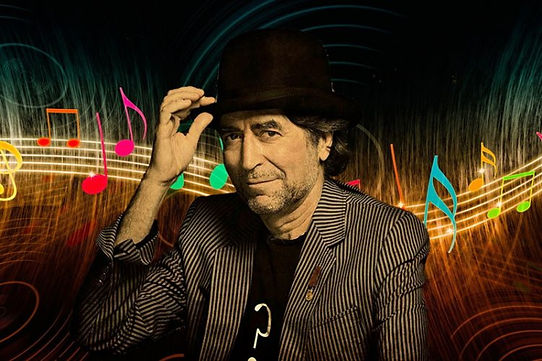
JOAQUÍN SABINA
“Y Morirme contigo si te matas
Y Matarme contigo si te mueres
Porque el amor cuando no muere mata,
Porque amores que matan nunca mueren”
"B"
Main Decade: 90’s
Main Eras:
Trova and Singer-Songwriters (1960-???)
Key Members:
Joaquín Sabina, Guitar and Vocals
Pancho Varona, Guitar and Arrangements
Antonio García de Diego, Guitar and Arrangements
Key Songs:
Contigo. 19 Días y 500 Noches, La del Pirata Cojo, Medias Negras, Calle Melancolía, Quien Me Ha Robado el Mes de Abril, Nos Sobran los Motivos, A La Orilla de la Chimenea, Y Nos Dieron Las Diez, Conductores Suicidas, Pero Qué Hermosas Eran, Yo Me Bajo en Atocha, Pongamos Que Hablo De Madrid, 69.G, Eva Tomando el Sol, Bruja, Princesa, Así Estoy Yo Sin tí, Mentiras Piadosas, Camas Vacías, Peor Para el Sol, Por El Bulebar de los Sueños Rotos, Ruido, Esta Boca Es Mía, Peces de Ciudad, Y Sin Embargo, Arenas Movedizas, Pastillas Para No Soñar, Noches de Boda, Yo Quiero Ser Una Chica Almodóvar
Joaquín Sabina is an exceptional case in the entire history of music. It's not rock, it's not a corny, simplistic ballad, it doesn't have the social commitment of the Trova movement by any stretch of the imagination, and it's the most distinct of that group of Latin American singer-songwriters like Fito, Charly, Silvio, Pablo, or Aute, with whom he's often pigeonholed... Sabina's style is unique and incomparable. I find it very difficult to define. Sabina plays with so many rhythms and textures in his songs that practically the only genre I haven't heard him sing is metal, but he dares to explore everything else without prejudice, and most of the time, with considerable success.
So, to define his vast and varied repertoire, I can't find a more fitting word than "Arrabalero" (meaning "streetwise" or "working-class"). Yes, Joaquín Sabina can sing blues, ballads, rock and roll, rancheras, country, huarachas, sones, and even rap, with different themes, but the spirit of his songs always retains the aroma of a tavern with plenty of whiskey, smoke, and women in black stockings. A true working-class man.
Another thing that fascinates me about El Flaco is that despite having almost twenty albums and being one of the most beloved and followed musicians in his native Spain and Latin America, his main passion doesn't seem to lie in music. Sabina is a writer at heart who, by a twist of fate, became something akin to a rock star, something like Julio Cortázar, but in reverse. Sabina's lyrics are little gems, beautifully crafted and nourished by the best poets of the Spanish Golden Age. They are almost always perfect sonnets, so rare and difficult to find these days, especially given their fresh sound and contemporary language, which at times borders on the vulgar and at others crosses that line into something deliciously obscene. Despite having been an idealist in his youth, and even exiled to London for his radical leftist leanings and opposition to Franco, Sabina's work is practically devoid of any political commitment. In fact, he only addresses two themes: infidelity and himself. This is the main reason why I don't categorize him as "A," and it almost got me to put him in "C," but frankly, sticking to those two topics without offending us requires considerable skill.
While in London, he wrote his first songs, began his nocturnal wanderings through bars, and took his first steps as a womanizer, abandoning his first wife. Legend has it that in 1974, George Harrison went to the bar where the then-young Joaquín was singing and was so impressed that he gave him a 5-pound tip. Later, after Franco's death, he returned to Spain and had to complete his military service. One of the anecdotes that defines Sabina's later lifestyle occurred during this time: While stationed, he married Lucía Correa, an Argentinian friend and his first femme fatale. The curious thing about this marriage is that it happened because Sabina couldn't stand being confined to the barracks for another day and married her solely to get out. A day or two after the wedding, his new wife found him in bed with another woman.
In 1978, he began his recording career with what is perhaps his most political album, and the one most closely aligned with other singer-songwriters, Inventario. The songs “1968” and “Canción para manos de un Soldado” (Song for a Soldier's Hands) are examples of his biting political criticism. Personally, I prefer the style he would develop later, but this small sample proves he could have become a critic on par with Silvio Rodríguez. But he chose not to.
In 1979, he began singing with Javier Krahe and Alberto Pérez at the café “La Mandrágora,” and it was then that he decided to abandon the singer-songwriter archetype. For his second album, he deliberately avoided any political criticism and released several songs that have become immortal classics in his repertoire, such as “Calle Melancolía” (Melancholy Street), “Bruja” (Witch), and “Pongamos que hablo de Madrid” (Let's Say I'm Talking About Madrid), which became an unofficial anthem of the city. With this, his fame began to grow; he started appearing on television, and the small bars where he played were packed. Mind you, although Sabina stopped writing about politics, he began writing a kind of self-critique in which, ultimately, he still managed to take a swipe at more than a few people.
After releasing an album with Krahe and Pérez under the name "La Mandrágora," the group disbanded, and a third album with more rock-oriented songs was released. Throughout this time, he continued to contribute articles and reviews to the press, as well as writing poetry that was never set to music, which, in my opinion, were always his true passions. So much so that a few years ago he began to combine journalism with poetry, writing news stories in verse.
As the albums progressed throughout the 80s, Sabina gained increasing popularity, and his "Arrabalero" style became more defined song by song. Sabina gradually evolved, surrounding himself with increasingly better musicians until he formed a core group with Pancho Varona and Antonio García Diego, who ultimately gave his music a definitive style (if such a thing is possible amidst the tremendous variety of genres) and who accompany him to this day.
Thus, Sabina began to make his mark in Latin America, continuing to release great classics on every album. In the early 90s, he achieved massive fame and released a string of phenomenal albums, practically without filler, which cemented his status as an idol throughout the decade: Física y Química (one of his best, in my opinion), Esta Boca es Mía, Yo Mi Me Conmigo, Enemigos Íntimos (recorded with Fito Páez), and 19 Días y 500 Noches (another of his best). This is another reason why I rate him so highly. El Flaco is one of the very rare exceptions to my theory that no group or solo artist can last more than 5-6 years at their peak. Sabina did it for an entire decade without any dips in popularity.
In these albums, Sabina consolidates his artistry: superior lyrics, ironic like those in "Suicidal Drivers," moving ballads like "With You" and "By the Fireside," and uproarious gems like "I Want to Be an Almodóvar Girl" and "The One About the Lame Pirate." He even ventures into rap with Manu Chao on "I Can't Stand Rap," delivers a bold religious critique with "Magdalene," and is even more incisive and sincere in his self-criticisms, such as "We Have More Than Enough Reasons," "At Forty-Ten," and "19 Days and 500 Nights," achieving in every lyrical style some verses and metaphors of breathtaking beauty. Furthermore, Varona and García Diego finally provide him with the musical talent and support that El Flaco had lacked in the 80s, creating the perfect atmosphere for the lyrics in every note.
The 1998 album “Enemigos Íntimos” deserves special mention. Recorded with Fito Páez, who wrote half the songs in Argentina, it sounds very different. I don't know if Pancho Varona and García Diego accompanied him in the studio, but it sounds much more like Fito's style, especially in the duet collaborations. I suppose that's why things ended so badly between them; after all, we all know what happens when you put two egos that big in a studio. However, perhaps to impress his colleague, Sabina manages to produce some of his best lyrics. “Yo me bajo en Atocha” is a beautiful song in which he portrays his beloved Madrid. Watching the images of the burning trains on 11-M with this song playing in the background, it seems as if it were expressly written to comfort the people of Madrid at that moment. And I don't know if anyone could watch those images with this song playing in the background without getting a lump in their throat.
In short, this album was 70% Fito's, but the result was that they stopped speaking to each other for quite some time, and obviously, the long-awaited tour never materialized.
In 2000, he released a live album, "Sabina y CIA," with some friends and guests, and several concerts and tribute albums by other artists were released in honor of the already legendary Spanish artist.
In 2001, after finishing recording his next album, Sabina suffered a minor stroke. More than damaging his health, the incident affected his mood, and he fell into a deep depression, which kept him away from the studio for about five years. However, in 2002, he released "Dímelo en la Calle," which he had already recorded. The album features the self-critical songs "Arenas Movedizas" and "Peces de Ciudad," as well as "Como un Dolor de Muelas," half of whose lyrics were written by Subcomandante Marcos; Sabina completed the rest, once again demonstrating his stance without speaking out directly. He still managed to start the tour, which was the first time I saw him live, and I heard his raspy voice and his passion for over two hours, although he certainly looked tired and diminished. The tour was canceled shortly after, citing throat problems, but the truth is the guy was quite depressed.
During this five-year hiatus, he dedicated himself to writing and began penning news articles in verse for Interviú magazine. He also released the CD "Diario de un Peatón" (Diary of a Pedestrian) with the remnants of his previous album, which is quite noticeable in the quality of the material. Sabina's health was clearly broken by years of excess with alcohol, drugs, and cigarettes… and his spirit was broken by so many failed relationships with women. Despite his attempts to portray himself as a misogynist and incorrigible womanizer, basing his fame and persona on this, his lyrics began to reveal loneliness, fear of aging, and a longing for a stable relationship. Although in his autobiography "En Carne Viva" (Raw Flesh) he claims to have had five femme fatales (some portrayed in the song "Pero Qué Hermosas Eran" - But How Beautiful They Were), there were many more "non-fatal" women who drained his energy and kept him alive at the same time. So Joaquín spent five years in musical silence, taking a break from touring, rethinking things, and regaining his energy, although he wouldn't be long in returning to his old ways with women and alcohol.
In 2005, seemingly more recovered, he released a somewhat more solid album: "Alivio de Luto" (Relief from Mourning), titled in reference to himself, and decided to organize the "Ultramarina" tour to promote it. In Gijón, he had to leave the stage almost immediately because his voice gave out, which alarmed critics and fans alike. But he recovered and continued the massive tour, arriving in Guadalajara in December to close with the headline concert at the 2006 Guadalajara International Book Fair (FIL). I saw him much more animated, full of energy, and optimistic than the last time. He tried to please the packed venue, but despite playing for about three hours, there was still much more to play. No problem. In cases where the repertoire is so vast, it would be unfair to ask the artist to work himself to the bone on stage for four or five hours, unlike, for example, Soda Stereo, right?
Finally, in 2007, he started another tour with his longtime friend Joan Manuel Serrat, called "Two Birds with One Stone." Unfortunately, I was clueless and only found out about the concert the day after they performed in my city.
Anyway. As I've already said, Joaquín is a very strange phenomenon, difficult to explain. Why so much success? I'm not sure. He's not aimed at a young audience, and yet he has three generations of fans at his feet, the latest younger than mine. His themes are very simple and passionate. He talks about instincts, seduction, and black stockings. He talks about loneliness and fears of failure, and the bitter taste of liquor and sleepless nights. He talks about the fear of growing old, something to applaud for someone his age. But he does it with a sincerity, passion, and literary mastery that seduces and captivates from the very first verse. Sabina plays with metaphors, employing lyrical figures of speech and double meanings, and at times his protest is so disguised in high heels and princesses that it's difficult to decipher the true meaning of his words. But generally, it's the simple themes of the dandy and his lifestyle that make us fall under his spell.
Sabina isn't a persona. He didn't enter the music industry to become a rock star, like so many other wannabes who are around. In fact, I think he's the figure he is, much against his will. He keeps reminding us that he's the last true Don Juan on the planet, a seductive gentleman in the old style who forgets names and all that; and as long as he continues to make us laugh, cry, envy him, or question ourselves about the personal dilemmas we see reflected in the way he does, he deserves my applause.
Words fail me when describing someone who defies definition... Outspoken, with a raspy voice, a portraitist of moments and feelings. Capable of crafting the most delicate love song, like "Contigo," which, when dedicated to any woman, can make her melt, or the most misogynistic anthems, like "Peor Para el Sol." Songs for the therapist's couch, where one searches for one's own meaning. Odes to his city and his homeland. Tributes to the Mexico that deserves his admiration and affection.
The eternal resident of number 7, Melancholy Street: Joaquín Sabina.
By Corvan
Dic/31/2007